
Short Summary
Search behavior is changing fast. Buyers now ask questions directly to AI tools like ChatGPT, Google AI Overviews, and Perplexity instead of only typing keywords into Google. This shift means businesses need more than traditional SEO. This article breaks down SEO vs AEO vs GEO, explains how they work together, and helps decision-makers understand what to prioritize in 2026 and beyond.
Introduction
Most businesses still think of search as one channel: Google.
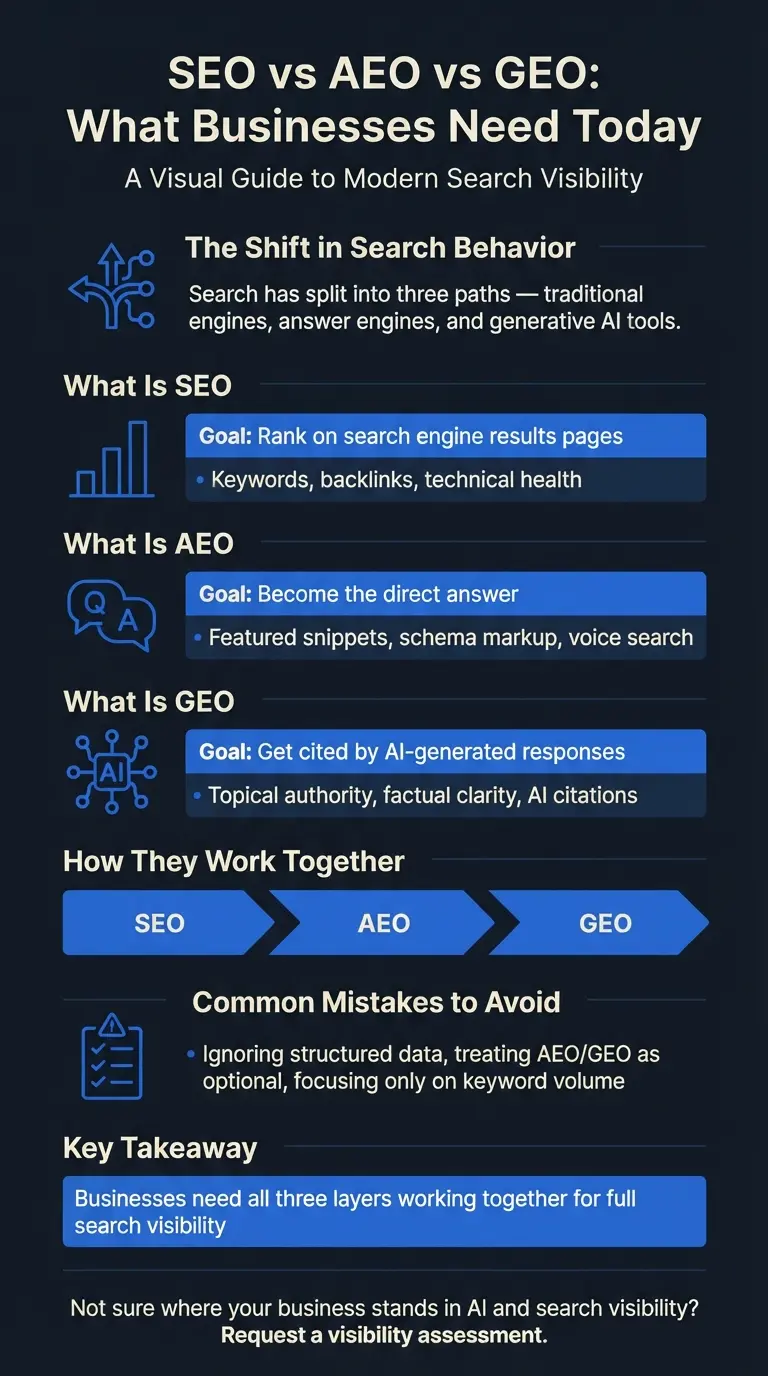
But the way people find information has split into three distinct paths. Traditional search engines, answer engines, and generative AI tools now compete for the same attention.
If your visibility strategy only covers one of these, you are leaving revenue on the table.
In this article, you will learn what SEO, AEO, and GEO actually mean, how they differ, and how to build a strategy that covers all three without wasting budget.
Key Takeaways
- SEO, AEO, and GEO are complementary, not competing strategies.
- AEO focuses on becoming the direct answer, not just a ranked link.
- GEO determines whether your brand gets cited by AI tools.
- Structured, clear, fact-based content performs better across all three.
- Businesses that delay AEO and GEO risk losing visibility to competitors who adapt first.
What Is SEO?
Search Engine Optimization (SEO) is the practice of improving a website’s visibility in traditional search engine results pages, primarily Google and Bing.
SEO focuses on:
- Keyword targeting.
- Technical site health.
- Backlink authority.
- On-page content structure.
- User experience signals.
SEO is built for ranking pages. It answers the question: “How do we appear on page one?”
What Is AEO?
Answer Engine Optimization (AEO) is the practice of optimizing content so it can be pulled directly into answer boxes, featured snippets, voice assistants, and AI-generated summaries.
AEO focuses on:
- Direct, concise answers.
- Structured data and schema markup.
- FAQ formatting.
- Clear question-and-answer content blocks.
AEO answers a different question: “How do we become the answer, not just a link?”
What Is GEO?
Generative Engine Optimization (GEO) is the newest discipline. It focuses on how content gets cited, referenced, or summarized by generative AI tools such as ChatGPT, Gemini, Claude, and Perplexity.
GEO focuses on:
- Being cited as a trusted source in AI-generated responses.
- Content clarity and factual accuracy.
- Topical authority across a subject.
- Machine-readable structure.
GEO answers: “When AI generates an answer, does it mention us?”
How SEO, AEO, and GEO Work Together
These three are not competitors. They are layers of the same visibility strategy.
- SEO gets your site indexed, crawled, and ranked.
- AEO makes your content quotable and answer-ready.
- GEO ensures AI systems trust and cite your brand.
A page that ranks well, answers questions clearly, and is structured for machine understanding has the best chance of showing up everywhere a buyer looks.
Common Mistakes Businesses Make
- Treating AEO and GEO as “future” priorities instead of current ones.
- Ignoring schema markup and structured data.
- Publishing long content with no clear, extractable answers.
- Assuming AI visibility cannot be measured or influenced.
- Focusing only on keyword volume instead of topical depth.
Comparison Table: SEO vs AEO vs GEO
| Factor | SEO | AEO | GEO |
|---|---|---|---|
| Primary Goal | Rank on search engine results pages | Become the direct answer shown to users | Get cited inside AI-generated responses |
| Platforms | Google, Bing | Featured snippets, voice assistants, AI Overviews | ChatGPT, Gemini, Perplexity, Claude |
| Content Style | Keyword-optimized long-form pages | Concise, structured Q&A format | Authoritative, fact-dense, well-sourced content |
| Key Technical Element | Backlinks, site speed, crawlability | Schema markup, FAQ structure | Topical authority, clarity, citation-worthiness |
| Success Metric | Rankings, organic traffic | Snippet share, voice answer appearances | Brand mentions in AI responses |
Real-Life Example
Publicly observed scenario:
Many SaaS and finance websites restructured their blog content in 2024 and 2025 by adding clear FAQ sections, direct-answer summaries, and structured headings.
Situation:
These sites had strong SEO rankings but were rarely appearing in AI-generated answers or featured snippets.
Action:
They reformatted key pages with concise definitions near the top, added schema markup, and broke complex topics into clearly labeled question-and-answer blocks.
Outcome:
Publicly documented industry reports have noted increased appearances in AI Overviews and answer boxes for businesses that adopted this structure.
Lesson:
Ranking well is no longer enough. Content needs to be structured for both human readers and machine extraction.
Expert Recommendations
- Audit your top-performing pages for answer-readiness, not just keyword targeting.
- Add structured FAQ sections to core service and educational pages.
- Use schema markup consistently across the site
- Build topical depth instead of chasing isolated keywords.
- Monitor brand mentions across AI platforms, not just search rankings.
Closing Section
Search is no longer a single channel. It is a network of engines, answer boxes, and AI assistants, all competing to serve your customer’s next question.
Businesses that adapt their content strategy across SEO, AEO, and GEO position themselves to be found, trusted, and chosen, no matter where the search happens.
Not sure where your business currently stands across search, answer, and AI visibility?
Request a visibility assessment to see how your content performs today, and where the opportunities are.