
Summary
SEO in 2026 looks very different from what it was just a few years ago. Search engines now use AI to understand intent, context, and authority, not just keywords. For business owners and decision-makers who are new to SEO, understanding the modern landscape is essential before investing in any digital growth strategy. This guide breaks down what SEO actually means today, how it has evolved, what components matter most, and what a smart SEO strategy looks like for businesses competing in a fast-changing search environment.
Key Takeaways
- SEO in 2026 combines traditional search optimization with AEO and GEO for full-spectrum visibility.
- Technical health, content depth, and structured data are now the baseline requirements, not differentiators.
- AI-generated answers and generative tools have created new visibility layers that businesses cannot afford to ignore.
- Common beginner mistakes include keyword fixation, thin content, and treating SEO as a one-time project.
- The businesses winning at SEO today are investing in topical authority and AI-readiness simultaneously.
Why SEO Still Matters, But Works Differently Now
If you have searched for anything online recently, you have noticed something: the results page looks nothing like it did five years ago. AI summaries appear at the top. Answer boxes dominate the fold. Organic links have moved further down.
Yet SEO remains one of the highest-return channels for sustainable business growth.
The difference is that what “winning” at SEO means has fundamentally changed. It is no longer just about ranking for keywords. It is about being the most trusted, most relevant, and most useful source, in the eyes of both search engines and AI systems.
This guide will walk you through exactly what SEO means in 2026, what has changed, and what you need to focus on as a business owner or marketing lead.
What Is SEO? (The Modern Definition)
Search Engine Optimization (SEO) is the practice of improving a website’s visibility in search engine results to attract relevant, organic traffic.
In 2026, that definition has expanded. SEO now includes:
- Ranking in traditional Google search results
- Appearing in AI-generated answer summaries (also called AEO)
- Being cited by AI tools like ChatGPT, Gemini, and Perplexity (also called GEO)
- Showing up in featured snippets, knowledge panels, and People Also Ask boxes
SEO is no longer just a Google game. It is a visibility game across every platform where people search for information.
How SEO Has Evolved: 2020 vs. 2026
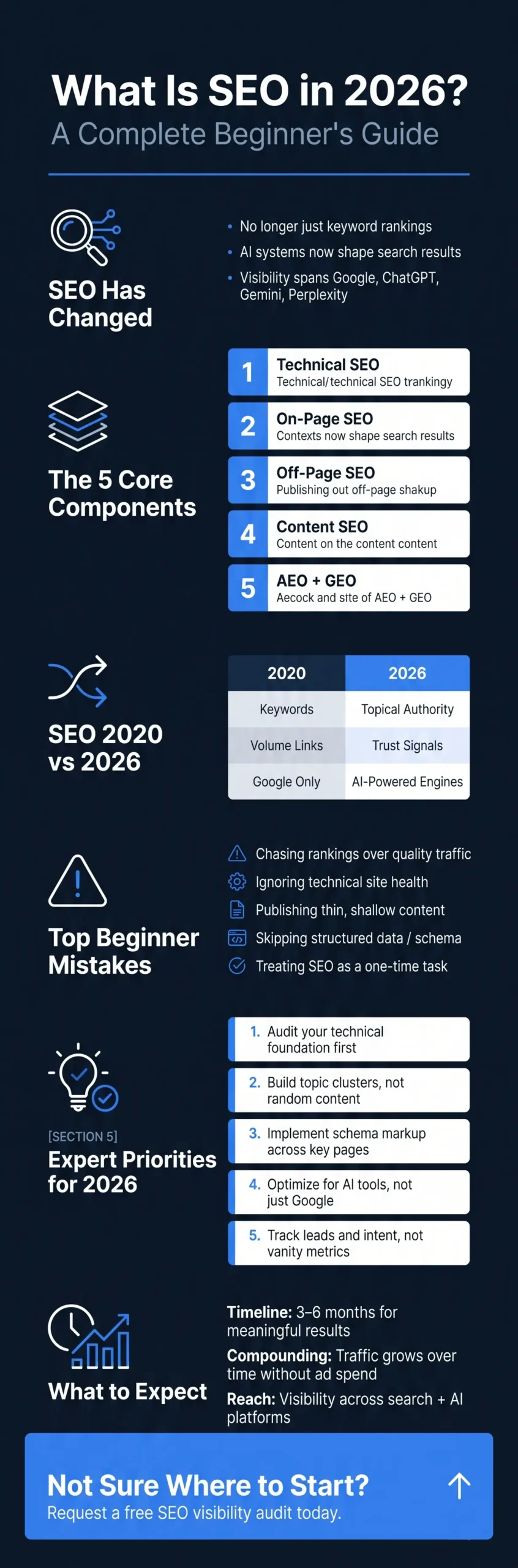
| Factor | SEO in 2020 | SEO in 2026 |
|---|---|---|
| Primary goal | Keyword ranking | Topical authority + AI visibility |
| Content focus | Keyword density | Semantic depth + entity coverage |
| Link building | Volume-focused | Trust + relevance signals |
| User intent | Basic match | Deep intent modeling |
| AI influence | Minimal | Core to how results are generated |
| Technical focus | Page speed, mobile | Core Web Vitals + structured data + schema |
| Answer engines | Not relevant | Critical ranking layer |
The shift from keyword-centric SEO to entity-based, intent-driven, AI-ready SEO is the single biggest change in the industry.
The Core Components of SEO in 2026
1. Technical SEO
This is the foundation. If search engines cannot crawl, index, or understand your site, nothing else matters.
Key areas:
- Site speed and Core Web Vitals scores
- Mobile responsiveness
- Clean URL structures and internal linking
- Structured data and schema markup
- Crawlability and indexation health
2. On-Page SEO
This covers everything on the page itself.
- Title tags, meta descriptions, and header hierarchy
- Content relevance and semantic coverage of a topic
- Internal linking to support topic clusters
- Optimized images, alt text, and page structure
3. Off-Page SEO
This is about how the internet perceives your authority.
- Backlinks from credible, relevant domains
- Brand mentions across the web
- Digital PR and earned media
- Social signals and community presence
4. Content SEO
Content is now the primary driver of topical authority.
- Long-form, comprehensive content that covers full topic clusters
- Answer-ready formatting (short answers, bullet summaries, FAQ sections)
- Regular updates to maintain freshness signals
- Content written for both users and AI understanding
5. AEO and GEO (The New Layers)
Answer Engine Optimization (AEO) focuses on getting your content selected as the direct answer in AI-powered search results and featured snippets.
Generative Engine Optimization (GEO) is the practice of ensuring your brand and content are referenced, cited, or recommended by generative AI tools like ChatGPT, Claude, Gemini, and Perplexity.
These are no longer optional. For businesses that want complete digital visibility, AEO and GEO are now core parts of any serious SEO strategy.
Common SEO Mistakes Beginners Make
Focusing only on rankings, not traffic quality. A page ranking #1 for the wrong keyword brings no qualified visitors.
Neglecting technical health. A slow, poorly structured site limits the impact of even the best content.
Publishing thin content. Short, surface-level content does not build topical authority and is increasingly filtered out by AI ranking systems.
Ignoring structured data. Schema markup is how you communicate content meaning directly to search engines and AI systems.
Treating SEO as a one-time task. SEO requires ongoing maintenance, updates, and adaptation as algorithms evolve.
How Modern SEO Works in Practice
Common implementation pattern:
A B2B software company wants to increase inbound leads from organic search.
Situation: Their website has 40 pages, mostly product descriptions. They have minimal blog content and no structured data.
Action: They invest in a full SEO audit, identify high-intent keyword clusters, build a content hub around their core service category, implement FAQ schema across key pages, and build backlinks through industry publications.
Outcome: Within six months, they see a 60% increase in organic traffic, several featured snippet placements, and their brand name begins appearing in AI tool responses when users ask about their category.
Lesson: SEO results compound over time. Starting with a solid foundation, technical health, topical content, and structured data, accelerates the timeline significantly.
Expert Recommendations for Businesses Starting SEO in 2026
- Audit before you build. Understand your current baseline: technical health, existing rankings, and content gaps.
- Define your topic clusters. Group your services and expertise into clear content themes and build depth in each.
- Invest in structured data. Schema markup directly improves eligibility for AI-generated answers and rich results.
- Think beyond Google. Optimize for how AI tools understand and cite your content, not just traditional search.
- Measure intent-matched traffic, not just volume. Track leads and conversions, not vanity metrics.
Start With Clarity, Not Complexity
SEO in 2026 is not out of reach for beginners. But it requires a clear strategy, a proper foundation, and a commitment to building real authority over time.
The businesses that win are not the ones trying every tactic. They are the ones that understand their audience, invest in depth over volume, and adapt quickly as the search landscape evolves.
If you are unsure where to start or want a clear picture of where your website stands today, a professional SEO audit is the most practical first step. It removes guesswork and gives you a prioritized roadmap based on your actual gaps and opportunities.
Ready to understand where your visibility stands? Let’s start with a conversation. Contact Us Now