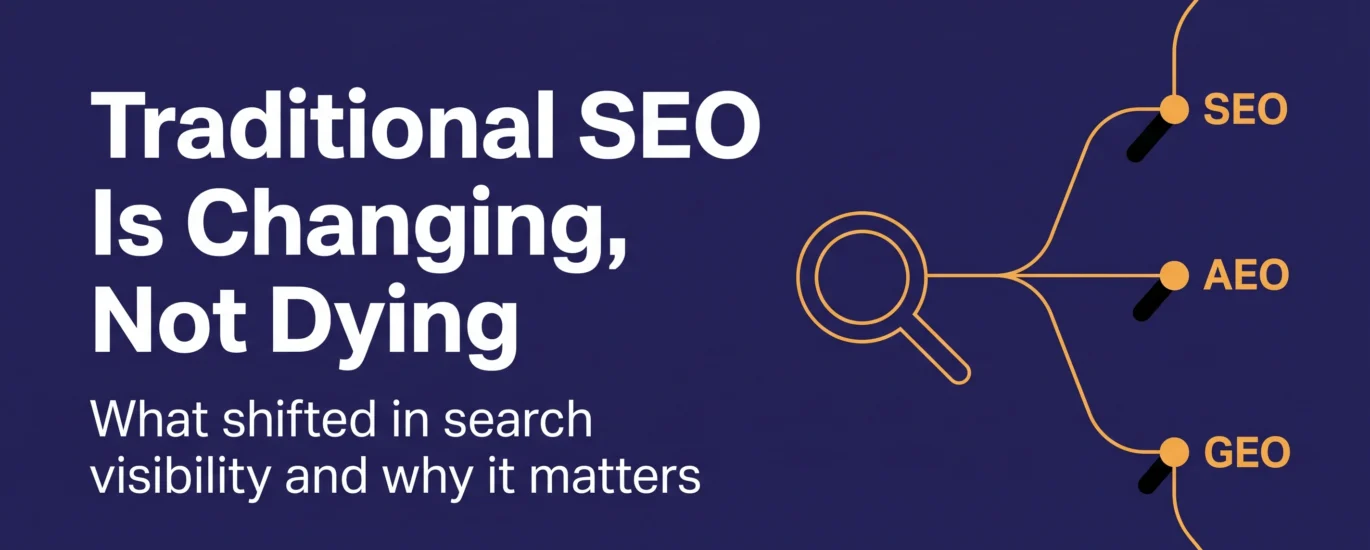
Traditional SEO built its reputation on a simple loop: research keywords, write content around them, earn backlinks, watch rankings climb. That loop still exists, but it’s no longer the whole game.
Search behavior has fractured. People ask questions inside ChatGPT, get summarized answers from Google’s AI Overviews, and increasingly skip the click-through step entirely. A page one ranking used to mean visibility. Now it sometimes means nothing, because the answer already appeared above the results.
This matters because budgets are still being allocated to strategies built for a search environment that’s partially gone. Teams optimizing purely for blue links are missing where a growing share of discovery now happens.
By the end of this piece, you’ll understand what specifically changed, how to evaluate whether your current approach is still working, and where to focus instead. We’ll also point to our SEO services page if you want a structured breakdown of how this applies to your own site.
What “Traditional SEO” Actually Meant
Traditional SEO refers to the discipline built around ranking web pages in classic search engine results: keyword targeting, on-page optimization, technical crawlability, and link building. It assumes a user types a query, scans ten blue links, and clicks one.
That assumption is the part under pressure. The mechanics of ranking still matter. What’s changed is what ranking actually earns you.
What Changed, Specifically
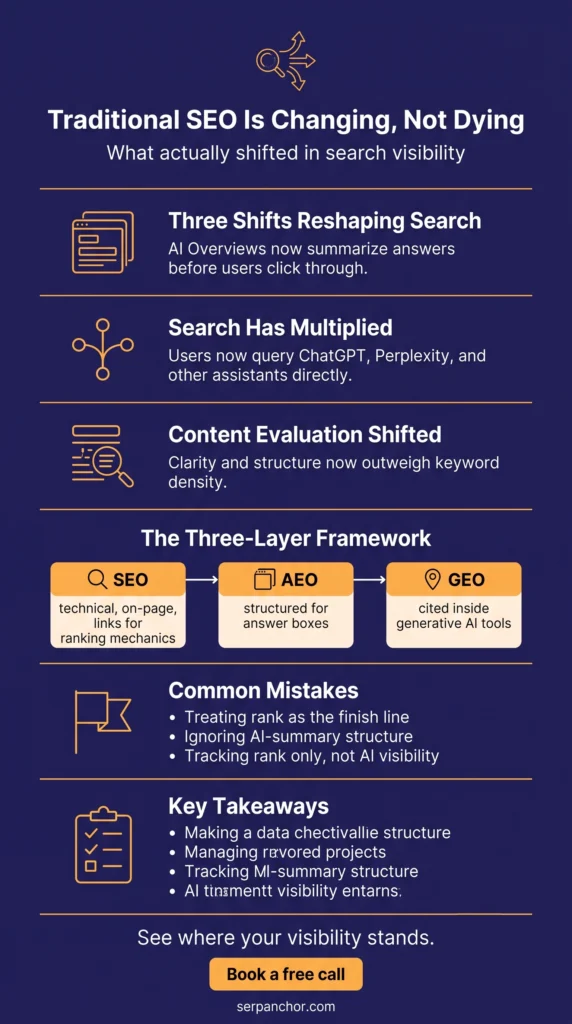
Three shifts are doing most of the damage to the old playbook.
1. Answer engines now summarize before you’re seen.
Google’s AI Overviews, Bing Copilot, and similar features generate a direct answer at the top of the page. Many users get what they need without scrolling further.
2. Search has multiplied beyond Google.
People now query ChatGPT, Perplexity, and other AI assistants directly for research and recommendations, bypassing traditional search engines entirely for certain tasks.
3. Content evaluation criteria shifted.
Ranking algorithms and answer engines increasingly weigh clarity, structure, and demonstrated expertise over keyword density. A page stuffed with a phrase 40 times reads worse to both humans and machines than it did a decade ago.
None of this means links, technical health, or on-page fundamentals stopped mattering. It means they stopped being sufficient on their own.
A Framework for Modern Visibility
Think of visibility today across three connected layers instead of one funnel.
- SEO — traditional ranking mechanics: technical health, on-page structure, backlinks, crawlability.
- AEO (Answer Engine Optimization) — structuring content so it gets pulled into direct-answer boxes and AI summaries.
- GEO (Generative Engine Optimization) — making your brand a citable, trustworthy source inside generative AI tools like ChatGPT and Perplexity.
A page can rank well under classic SEO and still be invisible in an AI-generated answer if it isn’t structured for extraction. That’s the gap most legacy strategies haven’t closed yet.
Common Mistakes
- Treating ranking position as the finish line instead of a means to visibility.
- Ignoring how content appears when pulled into an AI summary, not just how it looks on the page.
- Continuing to optimize for keyword volume while ignoring answer clarity.
- Assuming backlinks alone will offset thin or poorly structured content.
- Measuring success only through rank tracking tools, without checking actual referral and assistant-driven traffic.
Tools Worth Knowing
Google Search Console and Bing Webmaster Tools still matter for crawl and indexing health. Ahrefs and SEMrush remain useful for keyword and backlink research. For tracking how brands appear inside AI answers, teams are increasingly watching how their content gets cited or summarized directly within tools like Perplexity and ChatGPT, not just tracking rank position.
Business Implications
If leadership is still measuring SEO success purely by keyword rankings, that metric is telling an incomplete story. Traffic can decline even as rankings hold steady, because clicks are being absorbed by answer boxes.
The businesses adapting fastest are the ones treating content structure as a distribution decision, not just a writing task. That’s a mindset shift more than a tactical one, and it’s where a lot of internal resistance shows up.
Comparison: Approaches to Search Visibility
Approach | Primary Goal | Best For | Limitation |
Traditional SEO | Rank in classic search results | Long-term organic traffic, established queries | Doesn’t guarantee visibility in AI summaries |
AEO (Answer Engine Optimization) | Get pulled into direct-answer boxes | Quick-answer, informational queries | Requires tight structural discipline |
GEO (Generative Engine Optimization) | Become a cited source in AI assistants | Brand trust, referral from AI tools | Harder to measure with existing analytics |
Paid Search | Immediate visibility via ads | Short-term campaigns, product launches | Stops the moment budget stops |
This isn’t an either-or decision. Most durable strategies layer these approaches rather than picking one and abandoning the rest.
Real-Life Example
Publicly observed scenario: Since the rollout of AI Overviews, publishers across multiple industries have reported publicly, through industry commentary and search visibility discussions, that pages holding steady rankings still saw organic click-through rates soften for certain informational queries.
Situation: A page ranked in the top three positions for a common informational query, unchanged for months.
Action: The publisher restructured the content around a clear, direct answer near the top, added a scannable summary block, and kept supporting detail below.
Outcome: Publicly discussed cases suggest that content structured this way tends to retain a larger share of both traditional clicks and inclusion in AI-generated summaries, compared to pages that keep information buried deep in the copy.
Lesson: Ranking well is necessary but no longer sufficient. Structure now determines whether that ranking translates into visibility.
Expert Recommendations
Audit your top-performing pages for how they’d read if extracted as a two-sentence answer. If the core point isn’t clear within the first 100 words, an answer engine likely won’t surface it either.
Build a habit of checking how your brand or content appears when queried directly inside ChatGPT or Perplexity, not just Google. This is becoming a standard part of visibility reporting.
Keep technical SEO fundamentals in place. They remain the foundation everything else is built on. Skipping them to chase AI visibility trends is its own mistake.
Key Takeaways
- Traditional SEO mechanics still matter, but ranking alone no longer guarantees traffic.
- AI Overviews and assistant-based search have absorbed a meaningful share of clicks for informational queries.
- AEO and GEO extend SEO rather than replace it.
- Content structured for clear extraction performs better across both classic and AI-driven search.
- Visibility reporting needs to expand beyond keyword rank tracking.
Closing
Search hasn’t collapsed. It’s split into more surfaces, and each one rewards a slightly different kind of content structure. Teams that adapt their approach across SEO, AEO, and GEO together are the ones staying visible as this continues to play out.
If you want a clearer picture of where your current strategy stands, our SEO services team can walk through it with you.