For years, the goal of digital marketing was simple: rank #1 on Google. That single position drove traffic, leads, and revenue. But search behavior has changed. Buyers now ask AI assistants for recommendations, read AI-generated summaries, and skip traditional search results entirely. A #1 ranking still matters, but it no longer guarantees visibility. This article explains why traditional SEO alone is insufficient today, what has changed in how people find information, and what businesses need to do to stay visible across search engines, answer engines, and generative AI platforms.
Key Takeaways
- Ranking #1 on Google no longer guarantees visibility or leads.
- Buyers increasingly rely on AI-generated answers and summaries.
- AEO and GEO complement traditional SEO, they don’t replace it.
- Structured, clear content performs better across all search and AI systems.
- Businesses must track AI citations alongside traditional rankings.
Introduction
Most business leaders still measure SEO success by one metric: Google ranking position.
That mindset made sense for two decades. It doesn’t anymore.
Search behavior has fundamentally shifted. People now get answers directly from AI tools like ChatGPT, Google’s AI Overviews, and Perplexity, often without clicking a single link.
This means a business can rank #1 organically and still lose visibility where it matters most.
In this article, you’ll learn:
- Why traditional ranking metrics are becoming less reliable
- How AI-driven search is changing buyer discovery
- What replaces “ranking #1” as the new visibility standard
- Practical steps to stay visible across search and AI platforms
The Shift: From Search Results to Answers
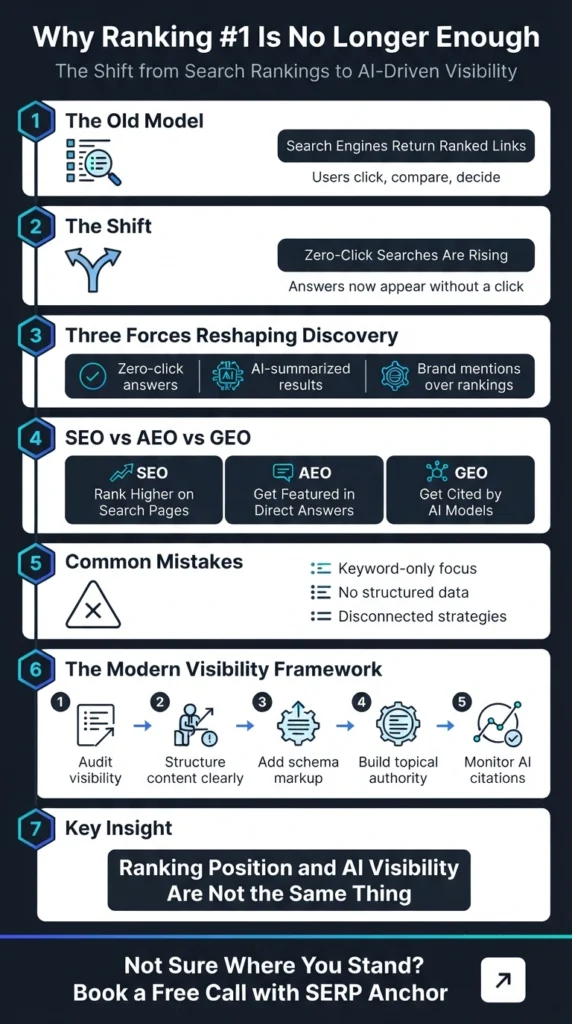
Search engines used to return a list of links. Users clicked, compared, and decided.
Today, many queries are answered directly on the results page or inside an AI chat interface.
This changes the competitive landscape in three ways:
- Zero-click searches are increasing. Users get answers without visiting websites.
- AI systems summarize multiple sources, not just the top-ranked page.
- Being mentioned matters as much as being ranked.
This is why SEO alone is no longer a complete strategy.
What AEO and GEO Actually Mean
AEO (Answer Engine Optimization) focuses on structuring content so it can be pulled directly into featured snippets, voice assistants, and AI-generated answers.
GEO (Generative Engine Optimization) focuses on making your brand and content more likely to be cited or referenced by generative AI tools like ChatGPT or Gemini.
Both work alongside SEO, not as replacements.
Approach | Primary Goal | Best For | Limitation |
Traditional SEO | Rank higher on search engine results pages | Organic traffic growth | Ignored by zero-click and AI-summarized searches |
AEO | Get featured in direct answers and snippets | Voice search, quick queries | Requires precise, structured content |
GEO | Get cited by AI models and chat tools | AI-driven research and recommendations | Harder to measure directly |
Paid Search | Immediate visibility through ads | Short-term lead generation | Visibility stops when budget stops |
Why Ranking Alone Fails Modern Buyers
Business buyers today research differently than they did five years ago.
They often:
- Ask AI tools for vendor comparisons
- Request summaries instead of reading full articles
- Trust AI-curated recommendations over browsing multiple sites
If your content isn’t structured for these systems, you become invisible in the exact moments buyers are making decisions.
Ranking #1 no longer guarantees you’re part of that conversation.
Common Mistakes Businesses Make
- Focusing only on keyword rankings, not answer accuracy
- Ignoring structured data and schema markup
- Writing content for search engines instead of clarity
- Not tracking mentions across AI platforms
- Treating SEO, AEO, and GEO as separate, disconnected efforts
A Practical Framework for Modern Visibility
- Audit your current visibility across search engines and AI tools, not just Google rankings.
- Structure content for clarity. Use direct answers, clear headings, and concise explanations.
- Implement schema markup to help both search engines and AI models understand your content.
- Build topical authority through consistent, well-organized content clusters.
- Monitor AI citations, not just search rankings, to understand real visibility.
Real-Life Example
Publicly observed scenario:
Many companies have reported strong Google rankings while noticing declining website traffic over the past year.
Situation: A business ranks on page one for its main keywords but sees a drop in inbound leads.
Action: Marketing teams began testing how AI tools like ChatGPT and Google AI Overviews answered questions related to their industry.
Outcome: In several publicly discussed cases, businesses found their content wasn’t being referenced at all, despite strong traditional rankings.
Lesson: Ranking position and AI visibility are not the same thing. Businesses need to measure both.
Expert Recommendations
- Treat SEO, AEO, and GEO as one integrated strategy, not separate projects.
- Prioritize content clarity over keyword density.
- Regularly test how AI tools respond to questions about your industry.
- Use structured data to improve machine readability.
- Track visibility across multiple platforms, not just Google Search Console.
Closing Section
Ranking #1 used to be the finish line. Now it’s just one part of a much larger visibility strategy.
Businesses that adapt to how buyers actually search, through search engines, answer engines, and AI platforms, will stay ahead of those still chasing traditional rankings alone.
If you want to understand where your business currently stands across search and AI visibility, a professional assessment can reveal gaps you may not see internally.
Book a free visibility assessment call today.