Search used to mean typing a query and scanning ten blue links. Now a growing share of buyers get their answer straight from an AI engine, no click required. This shift is quietly reshaping how companies get found, evaluated, and chosen. This article breaks down what’s actually changing in customer acquisition, why the old SEO playbook alone won’t cut it, and what founders and marketing leaders should do differently starting now.
Key Takeaways
- AI-generated answers are increasingly replacing the click-through search experience, especially for research-heavy B2B decisions.
- SEO, AEO, and GEO are related but distinct disciplines, each requiring different signals and different timelines.
- Being mentioned consistently across the wider web matters more for AI visibility than optimizing your own site alone.
- Most companies don’t know where they stand until they test it directly against real AI tools.
- This requires ongoing measurement, not a one-time project.
The Search Box Isn’t the Front Door Anymore
For twenty years, customer acquisition through search followed a predictable path. Someone types a question, Google returns a ranked list, and the buyer clicks through to research options.
That path is breaking.
Tools like ChatGPT, Perplexity, and Google’s AI Overviews now answer the question directly. No click. No visit to your site. The buyer gets a synthesized answer, often with a short list of recommended companies or products baked in.
If your business isn’t part of that answer, you’re invisible at the exact moment someone was deciding who to trust.
This isn’t a minor algorithm update. It’s a change in where the decision actually happens.
Why This Matters More For B2B Than People Realize
B2B buying cycles are long and research-heavy. A single deal might involve five or six people, each doing their own homework before a call ever gets booked.
Increasingly, that homework starts with an AI assistant, not a search bar. A CMO evaluating vendors might ask an AI tool to “compare the top options for X” before ever visiting a single vendor site.
If your content isn’t structured in a way these engines can pull from confidently, you don’t get considered. You don’t even get the chance to lose the deal. You just never show up.
Three Forces Reshaping Acquisition Right Now
There are three distinct but overlapping shifts happening at once, and most companies are only tracking one of them.
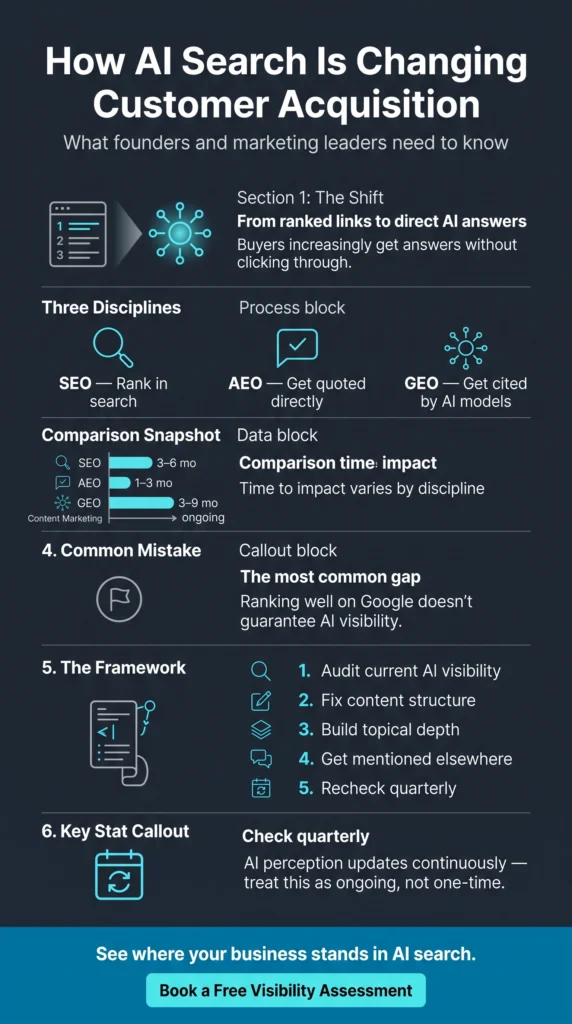
- Traditional SEO still matters, but it’s necessary, not sufficient.
Ranking on page one of Google still drives traffic. But it no longer guarantees visibility inside AI-generated answers, which pull from different signals and often summarize multiple sources into one response. - Answer Engine Optimization (AEO) is becoming its own discipline.
AEO focuses on structuring content so it can be directly extracted and quoted by AI systems and voice assistants. Clear, direct answers near the top of a page. Structured data. Content organized around actual questions people ask, not just keywords they type. - Generative Engine Optimization (GEO) determines whether you get cited at all.
GEO is about how large language models perceive your brand’s authority and relevance when generating an answer. It’s less about ranking and more about being recognized as a credible source worth referencing.
These aren’t three separate strategies competing for budget. They’re layers of the same visibility problem, and treating them as unrelated is one of the most common mistakes we see.
A Quick Way to Think About the Difference
Discipline | Primary Goal | What It Optimizes For | Where It Shows Up | Time to Impact |
Traditional SEO | Rank in search results | Keywords, backlinks, page authority | Google, Bing search pages | 3–6 months |
AEO | Get quoted directly | Clear structured answers, schema, FAQs | Featured snippets, voice assistants | 1–3 months |
GEO | Get cited by AI models | Brand authority signals, topical depth, mentions across the web | ChatGPT, Perplexity, Gemini, AI Overviews | 3–9 months |
Content Marketing | Build trust over time | Depth, originality, consistency | Blog, LinkedIn, industry publications | Ongoing |
Notice that GEO takes the longest to move. That’s not a flaw in the strategy. It’s because AI models build their sense of “who’s credible” from patterns across the entire web, not just your own site.
Where Most Companies Go Wrong
We’ve seen this go wrong in a pretty consistent way. A company optimizes hard for keywords, ranks decently, and assumes visibility is handled.
Then someone on the team asks ChatGPT a question related to their own industry. Their company doesn’t show up. A competitor does. Nobody had noticed until that moment.
The mistake isn’t laziness. It’s that AI visibility requires different inputs than search rank does. Things like:
- Being mentioned across multiple credible third-party sources, not just your own domain
- Publishing content that directly answers specific questions instead of circling a broad topic
- Using clear structure (headers, lists, defined terms) that AI systems can parse and extract cleanly
- Maintaining consistency in how your company describes what it does across every channel
- Getting cited, quoted, or referenced by other sites, even informally
None of this replaces good SEO. It sits alongside it.
Publicly Observed Scenario: The “Best Tools For X” Query
Here’s a pattern that plays out constantly and is easy to check yourself.
Situation: A buyer asks an AI assistant something like “what are the best project management tools for a 20-person marketing team.”
Action: The AI pulls together a short list, usually 3 to 5 names, drawn from patterns across review sites, comparison articles, forum discussions, and product pages that consistently describe those tools in similar, specific terms.
Outcome: Tools with scattered, inconsistent, or thin descriptions across the web rarely make the list, even if their own website is well optimized for Google.
Lesson: Visibility in AI answers depends on how consistently and specifically your company is described across the entire web, not just how well your own site is built. This is exactly the kind of signal GEO work is meant to strengthen.
You can test this yourself, right now, with your own category. Ask an AI tool who the best providers are. See if you’re mentioned. If not, that’s your starting point.
What Actually Works: A Practical Framework
Skip the theory. Here’s what we’d actually prioritize, in order, if we were starting from zero.
- Audit your current AI visibility. Ask the major AI tools questions your buyers would ask. Document what comes back.
- Fix your content structure before adding new content. Clear headers, direct answers, defined terms. Most sites need cleanup here before they need more volume.
- Build topical depth, not just topical breadth. One thorough guide beats five thin blog posts covering the same ground shallowly.
- Get mentioned elsewhere, intentionally. Guest content, expert quotes, industry roundups. This is slower work, but it’s what GEO actually depends on.
- Recheck quarterly. AI models update how they perceive brands as new content gets published across the web. This isn’t a set-it-once project.
This is the part most teams skip. They’ll rebuild their site, publish a dozen new pages, and never once check whether any of it changed how they show up in an actual AI-generated answer.
Expert Recommendations
Don’t treat SEO, AEO, and GEO as three separate budget lines. Treat them as one visibility strategy with three measurement points.
Prioritize clarity over cleverness in your content. AI systems reward direct, specific answers far more than they reward clever framing or brand voice.
And build a habit, not a project. Quarterly AI visibility checks should become as routine as checking your Google Search Console.
Closing
AI search isn’t replacing traditional search overnight, but it’s already changing where a meaningful share of buying decisions begin. Companies that show up consistently, clearly, and credibly across the wider web are the ones getting considered before a sales conversation ever starts.
If you’re not sure where your company stands in AI-generated answers, that’s worth finding out before a competitor figures it out first.
Curious where you actually stand? Book a free visibility assessment and see exactly how your business shows up across AI search tools today.