
Search behavior has quietly changed. A lot of people now ask a question and get an answer, not a list of websites to click through. That shift is the whole reason Generative Engine Optimization exists.
The problem is simple to state and harder to fix: most companies are still optimizing for a search experience that’s shrinking. Rankings still matter. But an AI-generated summary that never mentions your brand can cost you a customer who never even reaches page one.
This matters because generative answers are becoming a default entry point, not a novelty. Buyers ask ChatGPT to compare vendors. They ask Perplexity to explain a category before they ever open a browser tab full of search results. If your content isn’t structured in a way these systems can pull from, you’re not losing a ranking. You’re losing the conversation entirely.
By the end of this article, you’ll understand what GEO actually means, how it relates to (and differs from) SEO, a practical framework for approaching it, and the mistakes that tend to waste the most time.
What Generative Engine Optimization Actually Means
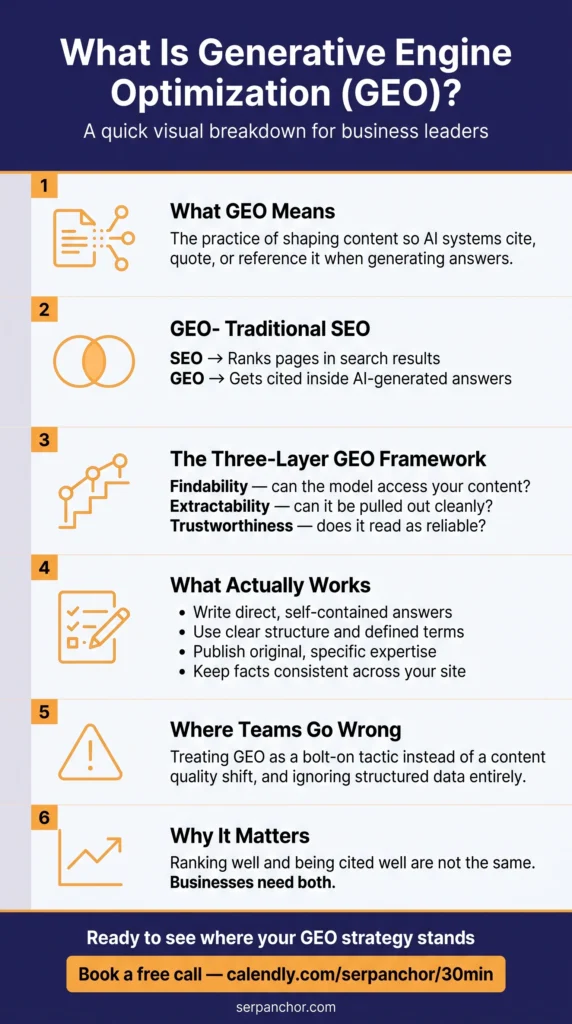
GEO is the set of practices used to increase the likelihood that AI systems cite, quote, or reference your content when generating an answer. That’s the whole definition. It sounds close to SEO, and it overlaps with it, but the mechanics are different.
Traditional search engine optimization is built around ranking a page for a query. A large part of that discipline is technical and structural, and it’s worth understanding that this overlaps directly with the fundamentals of search engine optimization, which still governs how content gets crawled, indexed, and trusted in the first place. GEO builds on top of that foundation rather than replacing it.
Generative engines don’t rank ten results. They synthesize one. That means your content is competing to be a source, not a listing. The unit of value shifts from a page to a passage, a stat, a clearly stated definition, a well-labeled comparison.
AEO and GEO Aren’t Quite the Same Thing
Answer Engine Optimization (AEO) and GEO get used interchangeably a lot, and that’s a little sloppy. AEO is generally about being the direct answer to a specific question, think featured snippets and voice search. GEO is broader. It’s about influencing how an AI model represents your brand or your point of view across an entire generated response, which might synthesize a dozen sources into one answer.
A Simple Framework for Thinking About GEO
Most teams get this backwards. They start by asking “how do I rank in ChatGPT,” which isn’t really how these systems work. A more useful framing has three layers.
Findability. Can the model’s underlying retrieval or training data actually access your content? This still depends heavily on solid technical SEO and clean site structure.
Extractability. Is your content written in a way that can be pulled out cleanly? Clear definitions, direct answers, well-structured data, these get quoted. Vague marketing copy doesn’t.
Trustworthiness. Does your content carry the kind of authority signals, citations, consistency, and specificity that make a model comfortable using it as a source?
Skip any one of these and the other two don’t matter much.
Actionable Guidance
A few things actually move the needle here:
- Write direct, self-contained answers to the questions your buyers ask, near the top of the page, not buried after 800 words of preamble.
- Use structured formatting: headers, tables, and defined terms. Models parse structure well.
- Publish original data or clearly labeled expertise. Generic restatements of common knowledge rarely get cited.
- Keep facts consistent across your own site and third-party mentions. Contradiction reads as unreliability to a model, the same way it does to a person.
This part usually gets skipped, and it shouldn’t: audit what AI tools are already saying about your brand or category before building a GEO plan. You can’t fix what you haven’t checked.
Common Mistakes
The biggest one is treating GEO as a bolt-on tactic instead of a content quality issue. Thin, keyword-stuffed pages don’t get cited more often just because someone labeled a section “AI Optimization.”
Another mistake: ignoring structured data entirely, on the assumption that it’s “just for Google.” Schema markup helps generative systems understand entities and relationships too.
And a smaller but common one: chasing every new AI platform individually instead of building content that’s genuinely strong at the source level, which tends to travel well across all of them.
Tools Worth Knowing
Tools like Google Search Console, Ahrefs, and Semrush still matter for the findability layer. For visibility into how AI tools reference your brand specifically, platforms like Perplexity’s own search and ChatGPT’s browsing mode are worth checking manually on a regular basis. There isn’t yet a single dominant analytics tool built purely for GEO tracking, and it’s worth being skeptical of anyone claiming otherwise.
Business Implications
This isn’t a marketing-department-only concern. Sales teams should know if a competitor is the one being recommended when a prospect asks an AI tool “what’s the best option for X.” Product and comms teams benefit from knowing how their category gets described by these systems, because that description shapes buyer expectations before a sales call even happens.
Comparison: Traditional SEO vs. GEO
Factor | Traditional SEO | GEO |
Primary goal | Rank in search results pages | Get cited or referenced in AI-generated answers |
Unit of value | Page/URL | Passage, fact, or clearly stated point |
Success signal | Ranking position, click-through rate | Citation frequency, brand mention in AI outputs |
Content style | Broad coverage, keyword targeting | Direct, extractable, well-structured answers |
Measurement maturity | Established (rank trackers, GSC) | Early-stage, largely manual monitoring |
Real-Life Example
Publicly observed scenario: A mid-sized B2B software company noticed that its category name kept surfacing in ChatGPT comparisons, but its own brand never appeared, even though it ranked on page one of Google for the same terms.
Situation: Strong traditional rankings, zero visibility in AI-generated comparisons.
Action: The team rewrote their core comparison and pricing pages using direct, structured answers instead of long narrative copy, and added clear, factual product specifications near the top of each page.
Outcome: Over the following months, manual checks across AI tools showed the brand starting to appear in generated comparisons where it previously didn’t.
Lesson: Ranking well and being cited well are not the same achievement. You can win one and lose the other entirely.
Expert Recommendations
Start with content that already ranks well and rework it for extractability first. That’s the fastest return. Don’t rebuild your whole content library around GEO before you’ve confirmed it’s changing anything for your specific buyers.
So treat this as an evolution of good content practice, not a separate department. The brands that will do well here are the ones that were already writing clearly and specifically, long before anyone used the term GEO.
Key Takeaways
- GEO is about being cited by AI-generated answers, not just ranking for keywords.
- It builds on solid SEO fundamentals rather than replacing them.
- Structure, clarity, and consistency matter more than keyword density.
- Measurement tools for GEO specifically are still early and largely manual.
- Content quality and extractability, not gimmicks, drive citation likelihood.
Conclusion
GEO isn’t a trend to bolt onto next quarter’s marketing plan. It’s a reflection of how people actually find information now, and that shift isn’t reversing. Businesses that adapt their content to be clear, structured, and genuinely useful to both humans and machines will keep showing up in the conversation. The ones that don’t will quietly disappear from it.
If your team is still treating this as a “someday” project, it’s worth running an honest SEO audit to see how your foundation actually holds up before layering anything new on top. This is exactly the kind of gap SERP Anchor has been fixing for teams for years now.